
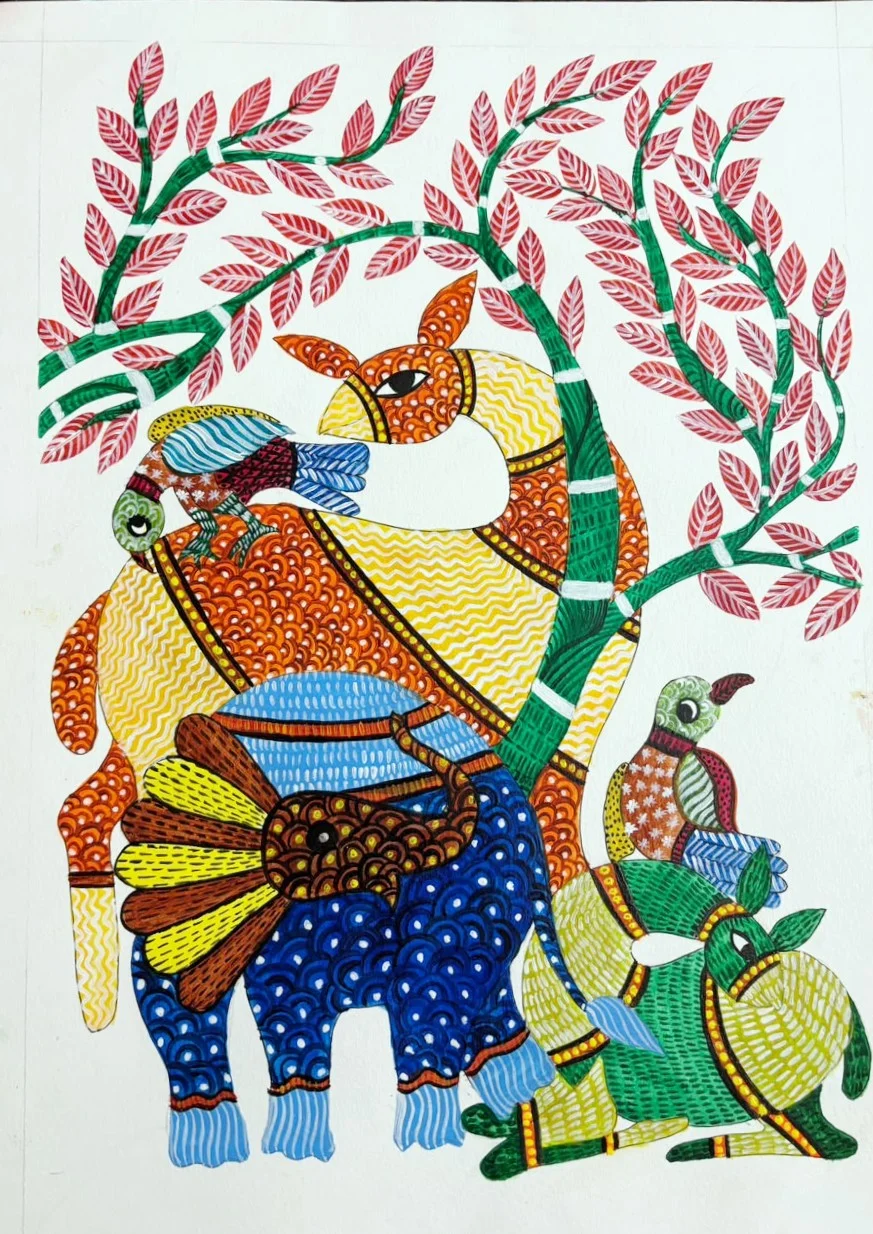
A deer whose body is made of tiny fish scales. A tree whose branches burst into birds. A peacock filled with dots and dashes that seem to vibrate. Gond art is instantly recognisable – and behind its joyful patterns lies a deep relationship between the Gond people of central India and the natural world they live in.
Where Gond painting comes from
The Gond are one of India’s largest Adivasi (indigenous) communities, living mainly in Madhya Pradesh and neighbouring states. Their visual tradition began on the walls and floors of village homes, painted for festivals and rituals. In the 1980s, the young Pardhan Gond artist Jangarh Singh Shyam from the village of Patangarh began painting these images on paper and canvas, encouraged by the artist J. Swaminathan at Bharat Bhavan in Bhopal. His work brought Gond art to galleries in India and around the world, and inspired a generation of Gond painters who continue to develop the style today. You can read more about Jangarh Singh Shyam on Wikipedia.
How to read a Gond painting
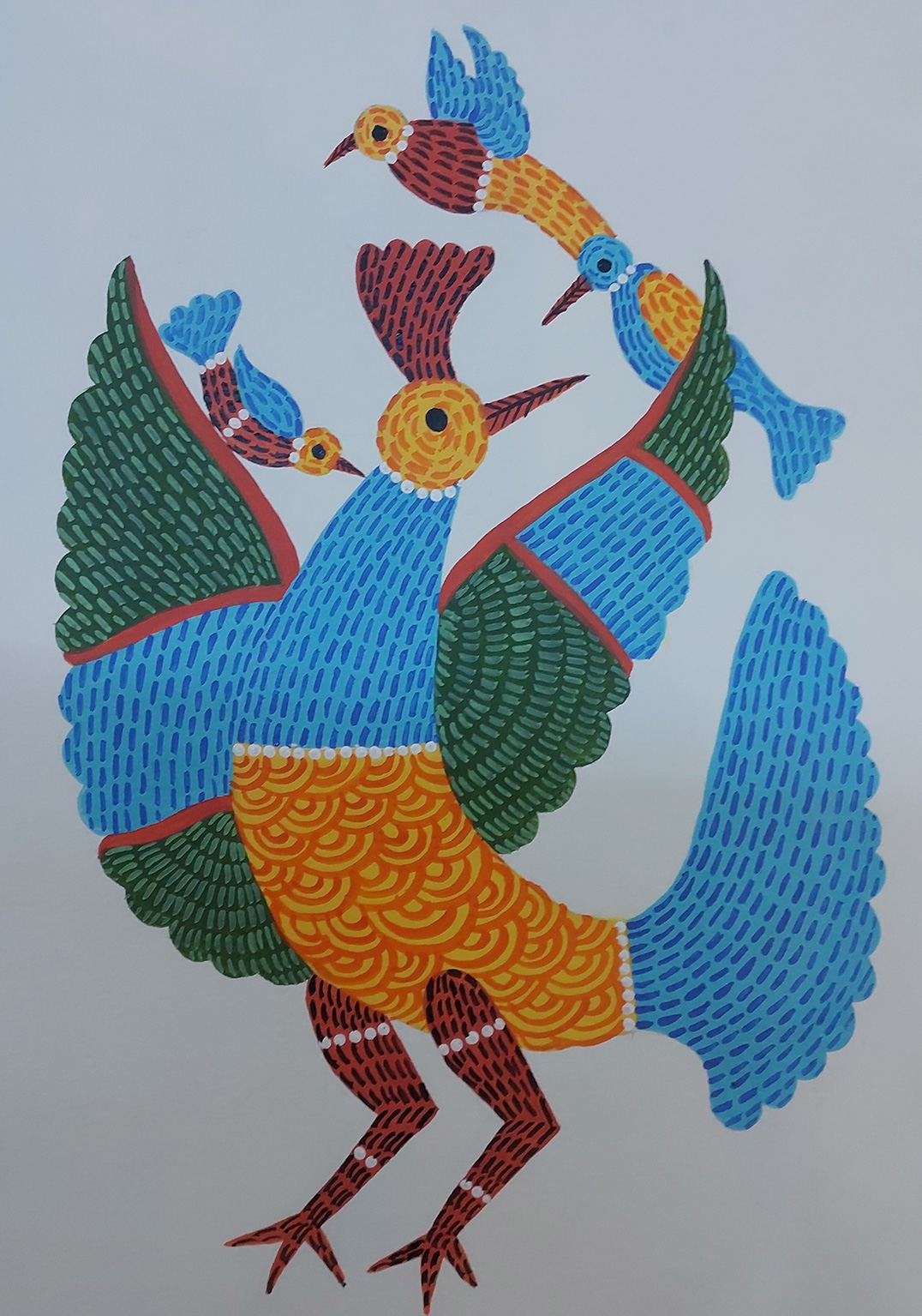
- Outline first, pattern second. Artists draw a bold outline of the subject, then fill it with repeating patterns.
- Signature patterns. Each artist develops a personal “signature” infill – dots, dashes, fish scales, seeds or wavy lines – that identifies their work.
- Nature as story. Trees, animals, birds and fish are the main characters, often illustrating folk tales, myths and the idea that all living things are connected.
- Movement through repetition. Thousands of small marks create a sense of vibration and life across the surface.
- Bright, contrasting colour on plain or dark backgrounds.
Why collectors love Gond art
Gond paintings work beautifully in contemporary homes: they are graphic and modern in feel, yet rooted in a living indigenous tradition. They suit children’s rooms, living spaces and offices alike, and a group of smaller Gond works can make a striking gallery wall. Buying an original also directly supports artists who are keeping this tradition alive.
Telling an original Gond painting from a print
Look closely at the infill patterns. In a hand-painted work, dots and lines vary slightly in size, spacing and pressure, and you can often see layering where one colour sits over another. Mass-produced prints are perfectly uniform and flat. For more tips, read our guide on how to tell an original painting from a print.
Gond paintings at Anandini Art Gallery
Our Gond painting collection is part of the gallery’s Living Traditions – original works alongside other Indian folk and tribal arts such as Phad and Kalighat Pattachitra. Contact us to arrange a viewing in Chandigarh.
Frequently asked questions
Gond art is a painting tradition of the Gond, an Adivasi community of central India. It depicts nature, animals and myths using bold outlines filled with patterns of dots and lines.
Jangarh Singh Shyam, a Pardhan Gond artist from Patangarh in Madhya Pradesh, brought Gond painting to national and international attention from the 1980s onwards.
The patterns bring the image to life and act as an artist’s signature. Each painter develops personal infill patterns such as dots, dashes, fish scales or seeds.