
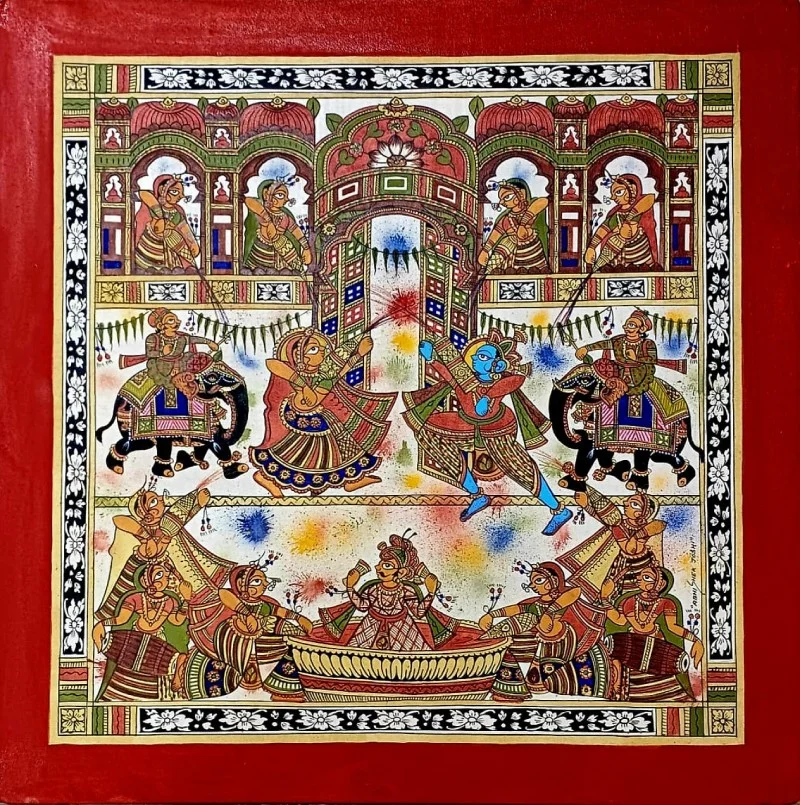
For centuries, villages in Rajasthan gathered after dark to watch a story unfold on cloth. A travelling priest-singer, the bhopa, would unroll a long painted scroll, light it with an oil lamp and sing the epic of a folk hero, pointing to each scene as the tale moved forward. That scroll is the Phad – one of India’s oldest living narrative painting traditions, and one of the most rewarding art forms to collect today. This Phad painting guide explains how the art form works, how to recognise it and what to look for when you buy an original.
What is a Phad painting?
A Phad (sometimes written Par) is a long horizontal painting on cloth that works as a portable temple and a visual script. The best-known Phads tell the stories of two deified heroes of Rajasthan – Pabuji, the protector of camels and herders, and Devnarayan, revered as an incarnation of Vishnu. Traditional scrolls can stretch many metres, packing dozens of episodes into one continuous composition. You can read more about Phad painting on Wikipedia.
The tradition is closely associated with the Bhilwara region and the town of Shahpura in Rajasthan, where families of Joshi painters have handed the craft down through generations. Today, contemporary Phad artists also paint smaller, framable panels and new subjects – such as the Hanuman Chalisa – while keeping the visual grammar of the old scrolls.
How to recognise the Phad style
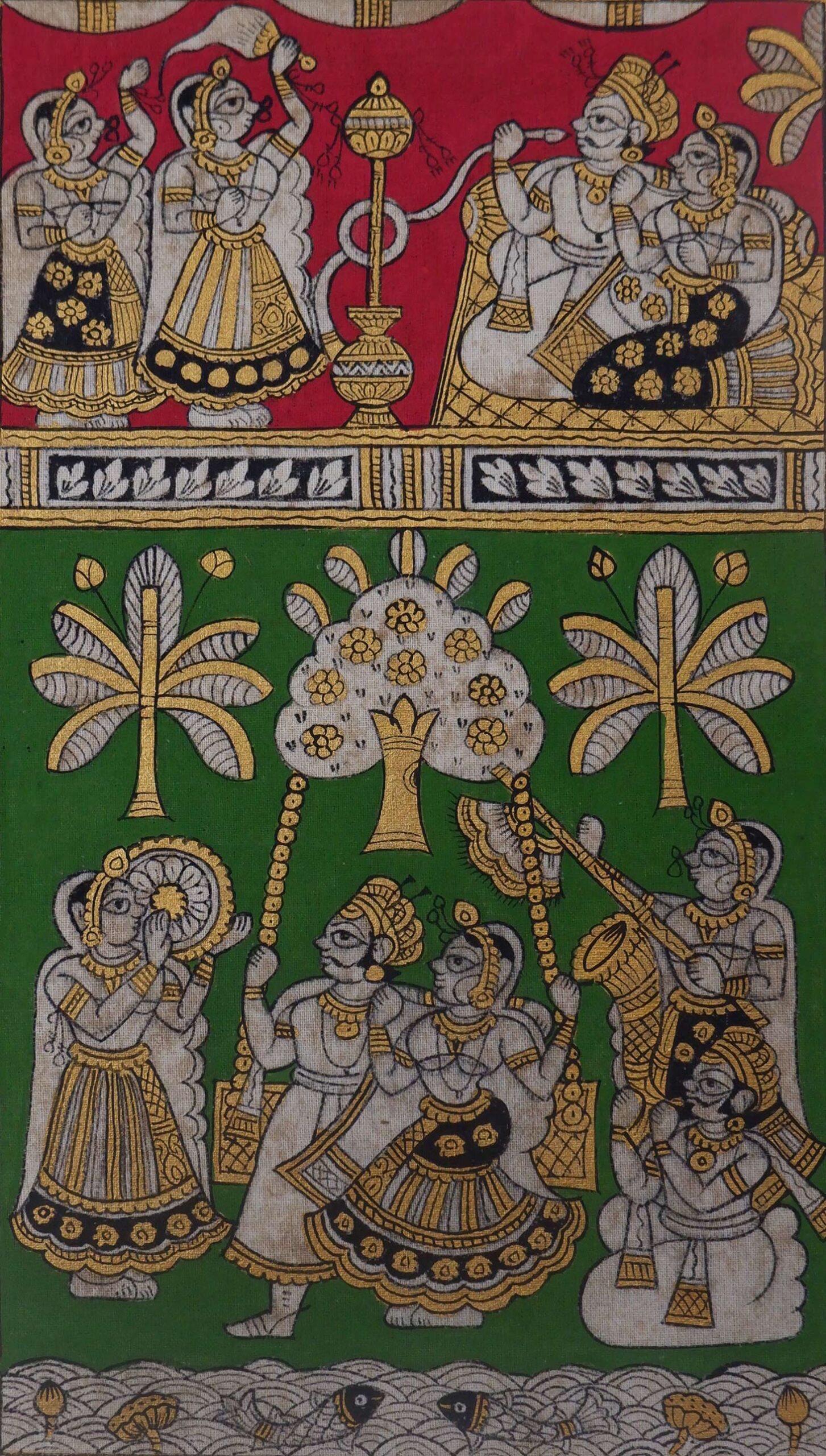
- A flat, frieze-like layout – scenes run side by side without perspective, divided by colour rather than borders.
- A dominant central hero – the deity is painted larger than everyone else, often on horseback, so viewers can find him instantly.
- A bold, limited palette – yellow and orange grounds, red, green and blue, with strong black outlines.
- Faces in profile with large almond eyes, and costumes and jewellery drawn in fine detail.
- Every space filled – trees, animals, architecture and attendants leave almost no empty cloth.
How a Phad is made
A genuine Phad is slow, hand-made work. The cotton cloth is first stiffened with a starch paste and burnished smooth so that colour sits evenly on the surface. The artist sketches the composition, then fills colours one at a time – traditionally prepared from minerals and plants – before finishing with the crisp black outlines that bring the figures to life. Large scrolls can take weeks or months to complete.
Because every stage is done by hand, no two Phads are identical. Small variations in line and colour are a sign of authenticity, not a flaw.
What to look for when buying an original Phad painting
- Look closely at the outlines. Hand-drawn lines vary slightly in thickness; printed reproductions are uniform and often show a dot pattern under magnification.
- Check the surface. Hand-applied colour has gentle texture and layering, and the starched cloth has a distinctive sheen.
- Ask about the medium. Natural colours on cotton or handmade canvas are typical of traditional Phad work.
- Ask where it comes from. A reputable gallery should be able to tell you about the work’s origin and the painter’s tradition.
- Buy for the story. Ask which episode or deity is shown – understanding the narrative makes the painting far more meaningful at home.
Phad painting guide: where to see originals
Our Living Traditions collection includes original Phad paintings in natural colours on traditional cotton canvas – from compact 8 × 8 inch panels that suit smaller walls to larger narrative works such as the Hanuman Chalisa Phad. Browse the Phad paintings collection, or explore related traditions such as Pichwai and Gond art.
If you would like to see a Phad in person or learn more about a particular work, contact the gallery in Sector 16, Chandigarh.
Frequently asked questions
Phad painting comes from Rajasthan, particularly the Bhilwara region and Shahpura, where families of Joshi painters have practised it for generations.
Traditional Phad scrolls narrate the epics of folk deities such as Pabuji and Devnarayan. Contemporary Phad artists also paint other devotional subjects, such as the Hanuman Chalisa.
Look for hand-drawn outlines of varying thickness, hand-applied colour with visible texture, and a starched cotton surface. Buy from a gallery that can explain the work’s origin.