
Few Indian paintings carry as much devotion – or as much detail – as the Pichwai painting of Nathdwara. Painted on cloth to hang behind the image of Shrinathji, the child form of Krishna worshipped at the temple town of Nathdwara in Rajasthan, Pichwais change with the seasons and festivals of the temple calendar. Today they are among the most sought-after forms of traditional Indian art for homes and collections.
What does “Pichwai” mean?
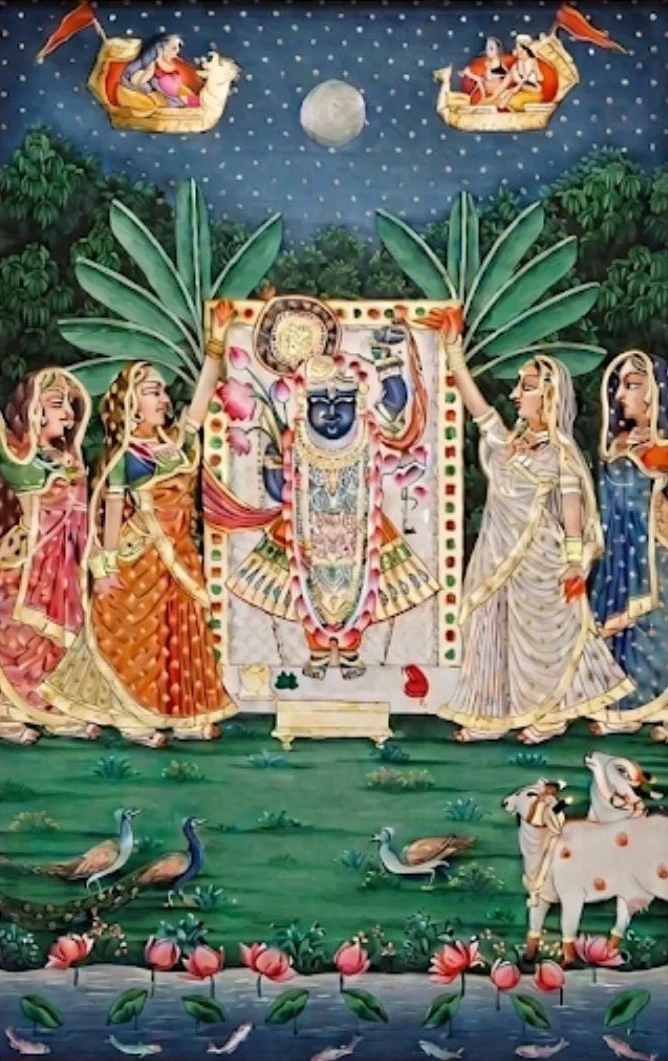
The word comes from pichh (back) and wai (hanging) – literally, “that which hangs behind”. In the temple, the Pichwai forms the backdrop to the deity, and it is changed to match the occasion: a festival, a season, or a particular moment in Krishna’s life. This is why Pichwai painting developed such a rich vocabulary of themes and motifs. You can read more about Pichwai on Wikipedia.
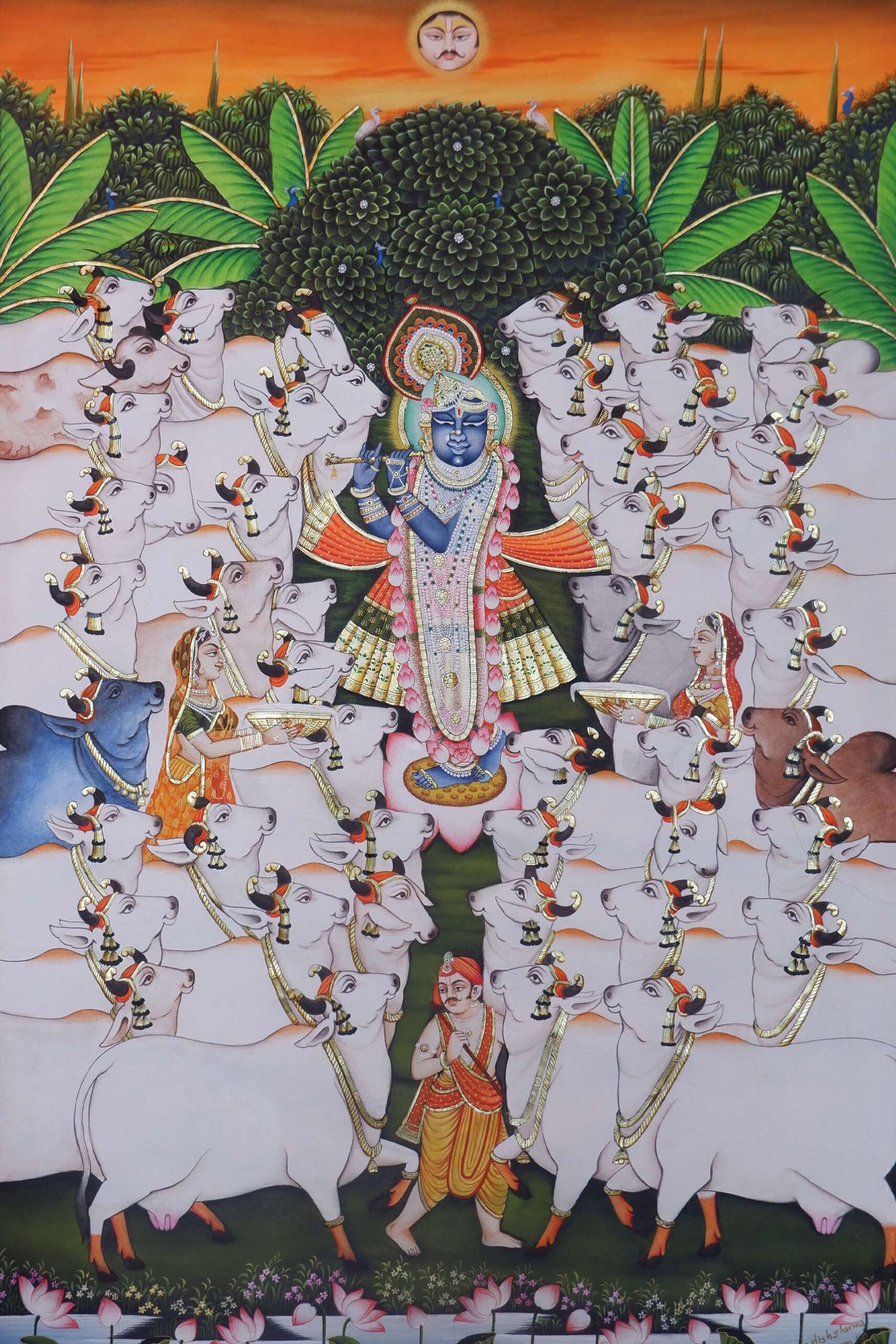
Common Pichwai themes and symbols
- Lotuses and lotus ponds – associated with summer and with purity; dense blooms, buds and leaves often fill the entire surface.
- Cows – a reminder of Krishna as the cowherd (Gopala); cow motifs are among the most loved Pichwai subjects.
- Shrinathji – shown with one arm raised, recalling the episode in which Krishna lifted Govardhan hill to shelter the villagers.
- Gopis and devotees – figures of worshippers and milkmaids, often in rows, celebrating festivals.
- Festivals and seasons – compositions for occasions such as Sharad Purnima, Annakut or the monsoon, each with its own colours and imagery.
How a Pichwai painting of Nathdwara is made
Traditional Pichwais are painted by hand on cotton cloth with fine brushes, using natural colours, and many are highlighted with gold. Artists build up the image in layers: a careful drawing, flat fields of colour, then intricate detailing of faces, jewellery, flowers and textiles. Large temple Pichwais can take a team of painters months to complete; smaller panels still demand days of patient work.
Choosing a Pichwai for your home
- Start with the theme. Lotus and cow Pichwais suit calm, contemporary interiors; Shrinathji compositions carry a stronger devotional presence and suit prayer rooms and entrances.
- Consider scale. A 24 × 36 inch Pichwai can anchor a living-room wall; smaller pieces work well in corridors and studies.
- Check the detailing. Look at faces, eyes and flowers up close – hand-painted work shows fine, confident brushwork.
- Frame with care. Use acid-free mounts and keep the painting away from direct sunlight to protect natural pigments (see our guide to caring for original artwork).
Pichwai paintings at Anandini Art Gallery
Explore original Pichwai paintings in natural colours on traditional cotton canvas in our Living Traditions collection. You may also enjoy reading about Phad painting, Rajasthan’s other great narrative tradition, and about Pahadi and Rajasthani miniature painting.
To view a Pichwai in person at our Chandigarh gallery, please get in touch.
Frequently asked questions
Pichwai paintings come from Nathdwara in Rajasthan, where they are painted to hang behind the image of Shrinathji, a form of Krishna.
Lotuses symbolise purity and are linked with summer, while cows recall Krishna as Gopala, the divine cowherd. Both are among the most popular Pichwai themes.
Choose by wall space: a 24 × 36 inch Pichwai suits a living-room feature wall, while smaller panels work well in corridors, studies and prayer rooms.